Thematic Search with Unsupervised Topic Modeling
In this page, we will create a TopicDatabase of the United Nations General Debate Corpus so we can do Thematic Search.
This corpus does not come with any topic metadata, so our first step is to generate a topic hierarchy and assign topic strengths to each document in the dataset. To do this, we will be using a typical unsupervised topic modeling pipeline: vectorize the documents, dimension reduce, cluster, and then represent the clusters with topic metadata.
Setting up the Topic Database
The first steps in the topic modeling pipeline is to chunk our documents and embed the chunks. As this is standard practice, we’re going to grab a copy of the dataset from HuggingFace that has pre-computed chunks, embedding vectors and UMAP reduced vectors. The dataset as well as more details on its creation is available here.
[1]:
import pandas as pd
import numpy as np

ungdc_df = pd.read_parquet("https://huggingface.co/datasets/kalebr/un-general-debate-corpus-chunked/resolve/main/ungdc-all-chunked.parquet")


embedding_vectors = np.stack(ungdc_df['embedding'].values)
reduced_vectors = np.stack(ungdc_df['reduced'].values)
text = ungdc_df['chunk_text'].to_numpy()

ungdc_df.head(1)
[1]:
| original_index | chunk_text | token_count | embedding | reduced | session | year | country | information_weight | |
|---|---|---|---|---|---|---|---|---|---|
| 0 | 0 | It is indeed a pleasure for me and the member... | 107 | [0.0061351038, 0.020647585, 0.01789057, 0.0222... | [6.317007541656494, 7.351022243499756] | 44 | 1989 | MDV | 39.726044 |
Computing a Topic Hierarchy
Next, we will use Toponymy to generate a topic hierarchy and assign topic labels to the chunks in our dataset. Toponymy first uses HDBSCAN to generate a set of cluster layers that are organized into a tree, and assigns each vector a cluster label for each layer of the hierarchy (possibly -1 for noise). Then it uses an LLM to generate topic names for each cluster by passing it context about the cluster, such as keyphrases and example snippets.
First we need to initialize our LLM wrapper - I am using Claude 3 Haiku - and then we need to set up our Toponymy parameters.
[2]:
## Toponymy LLM Wrapper Setup
from toponymy.llm_wrappers import AnthropicNamer

llm = AnthropicNamer(
    api_key="your-api-key-here",
    model="claude-3-haiku-20240307",  # Fast and cost-effective
    llm_specific_instructions="Generate coherent, descriptive names"
)

## Toponymy settings
model_name = 'all-MiniLM-L6-v2' # embedding model.

toponymy_object_description = "excerpts from a speech"
toponymy_corpus_description = "United Nations General Debate Transcripts"

toponymy_exemplar_method = "central"
toponymy_keyphrase_method = "information_weighted"
toponymy_subtopic_method = "facility_location"

clusterer_params = {
    'min_clusters':4,
    'base_min_cluster_size':25,
    'verbose':True
}
[3]:
import os
print(os.getcwd())
C:\Users\User\Documents\topicdb
Next, we can run Toponymy. Since I’ve already run it myself, I am going to load the serialized output instead:
[4]:
from toponymy.serialization import TopicModel
from sentence_transformers import SentenceTransformer
import torch

if False:
    from toponymy import Toponymy, ToponymyClusterer

    device = 'cuda' if torch.cuda.is_available() else 'cpu'
    print(f"Using device: {device}")

    model = SentenceTransformer(model_name, device=device)
    print(f"Loaded model: {model_name}")

    clusterer = ToponymyClusterer(**clusterer_params)
    clusterer.fit(reduced_vectors, embedding_vectors)
    toponymy_params = {
        'llm_wrapper':llm,
        'text_embedding_model':model,
        'clusterer':clusterer,
        'object_description':"excerpts from a speech",
        'corpus_description':"United Nations General Debate Transcripts",
        'exemplar_delimiters':["<EXAMPLE_TRANSCRIPT>\n","\n</EXAMPLE_TRANSCRIPT>\n\n"],
    }
    toponymy_fit_params = {
        'exemplar_method':toponymy_exemplar_method,
        'keyphrase_method':toponymy_keyphrase_method,
        'subtopic_method':toponymy_subtopic_method,
    }

    toponymy = Toponymy(**toponymy_params)
    toponymy.fit(text, embedding_vectors, reduced_vectors, **toponymy_fit_params)

    topicmodel = TopicModel.from_toponymy(toponymy, document_df=df)

if True:
    from pathlib import Path

    device = 'cuda' if torch.cuda.is_available() else 'cpu'

    if not Path('ungdc-full-topic-model.tm.zip').is_file():
        !curl -O https://huggingface.co/datasets/kalebr/un-general-debate-corpus-chunked/resolve/main/ungdc-full-topic-model.tm.zip

    model = SentenceTransformer("all-mpnet-base-v2", device=device)
    print(f"Loaded model: all-mpnet-base-v2")

    topicmodel = TopicModel.from_file('ungdc-full-topic-model.tm.zip')
Warning: You are sending unauthenticated requests to the HF Hub. Please set a HF_TOKEN to enable higher rate limits and faster downloads.
MPNetModel LOAD REPORT from: sentence-transformers/all-mpnet-base-v2
Key                     | Status     |  |
------------------------+------------+--+-
embeddings.position_ids | UNEXPECTED |  |

Notes:
- UNEXPECTED    :can be ignored when loading from different task/architecture; not ok if you expect identical arch.
Loaded model: all-mpnet-base-v2
Toponymy’s TopicModel class contains the following data from Toponymy:
The cluster_tree
topicmodel.cluster_treeThe topic representation metadata
topicmodel.topic_dfThe embedding vectors
topicmodel.embedding_vectorsThe reduced vectors
topicmodel.reduced_vectorsThe cluster inclusion matrices
topicmodel.cluster_layers
Conveniently, the TopicModel contains everything you need to build a TopicDatabase. For example, here is the topic metadata:
[5]:
topicmodel.topic_df
[5]:
| uid | layer | cluster | name | keyphrases | |
|---|---|---|---|---|---|
| 0 | AAAB | 0 | 0 | Conflict and political reconciliation in North... | [people of northern ireland, british and irish... |
| 1 | AAAC | 0 | 1 | Antarctica's status as the common heritage of ... | [question of antarctica, antarctic treaty, con... |
| 2 | AAAD | 0 | 2 | Implementation of South Tyrol Autonomy Agreeme... | [autonomy of south tyrol, austria and italy, r... |
| 3 | AAAE | 0 | 3 | Decolonization and self-determination of New C... | [people of new caledonia, south pacific forum,... |
| 4 | AAAF | 0 | 4 | Decolonization and self-determination of East ... | [people of east timor, leadership of fretilin,... |
| ... | ... | ... | ... | ... | ... |
| 613 | AAwE | 3 | 3 | Latin American Integration and Conflicts | [central american countries, government of gua... |
| 614 | AAwF | 3 | 4 | Congratulations and Tributes to UN Leadership | [election to the presidency, mr president, sir... |
| 615 | AAwG | 3 | 5 | Nuclear Disarmament and European Security | [non-proliferation of nuclear weapons, nuclear... |
| 616 | AAwH | 3 | 6 | UN Reform and Global Order | [disarmament, nuclear weapons, developing coun... |
| 617 | AAwI | 3 | 7 | Reforming Global Economic Order | [developing countries, terms of trade, new int... |
618 rows × 5 columns
Propagating Labels to Noise Points
Although we could make a TopicDatabase with what we have now, I want to first assign topic strengths to all the noise points by using scikit-learn’s LabelSpreading algorithm to predict soft inclusion strengths for each topic to each noise point, using the Topoynymy labels as training data.
[6]:
from sklearn.semi_supervised import LabelSpreading

spreader = LabelSpreading(kernel='knn')

soft_layers = []
for matrix in topicmodel.cluster_layers:
    labels = np.asarray(np.argmax(matrix,axis=1))
    spreader.fit(topicmodel.embedding_vectors, labels.flatten())
    soft_layers.append(spreader.label_distributions_)
Initializing the Topic Database
Now we have everything we need to initialize the topic database:
[10]:
from thematic_search import TopicDatabase, SoftClusterTree

topicdb = TopicDatabase(
    soft_cluster_tree=SoftClusterTree(
        soft_layers,
        topicmodel.cluster_tree,
    ),
    embedding_vectors=topicmodel.embedding_vectors,
    reduced_vectors=topicmodel.reduced_vectors,
    sample_df=ungdc_df.drop(columns=['embedding', 'reduced']),
    topic_df=topicmodel.topic_df,
    embedding_model=model
)
topicdb
[10]:
<thematic_search.topicdatabase.TopicDatabase at 0x2c4a16d4690>
Searching and Visualizing
Now with our chunk database and speech database both ready to go, lets go through some example usage.
First, lets query for high-level (layer>=3) topics in the speeches given by the Canadian delegation, with strength at least 0.75:
[12]:
topicdb.q.samples_where("country=='CAN'").topics(0.9).where('layer>=3').metadata()
[12]:
| uid | layer | cluster | name | keyphrases | |
|---|---|---|---|---|---|
| 610 | AAwB | 3 | 0 | Southeast Asian Geopolitics | [government of democratic kampuchea, vietnames... |
| 611 | AAwC | 3 | 1 | Middle East Conflicts | [palestinian people, israel, occupied arab ter... |
| 612 | AAwD | 3 | 2 | Decolonization and Anti-Apartheid | [people of south africa, south african governm... |
| 613 | AAwE | 3 | 3 | Latin American Integration and Conflicts | [central american countries, government of gua... |
| 615 | AAwG | 3 | 5 | Nuclear Disarmament and European Security | [non-proliferation of nuclear weapons, nuclear... |
| 616 | AAwH | 3 | 6 | UN Reform and Global Order | [disarmament, nuclear weapons, developing coun... |
| 617 | AAwI | 3 | 7 | Reforming Global Economic Order | [developing countries, terms of trade, new int... |
Next, we will find the 25 nearest neighbours of the embedding of “war between Iran and Iraq”, ask for the theme of that set and print it’s name.
Then we can take that theme and find all the documents in the theme with strength at least 0.9.
[13]:
topic = topicdb.q.neighbours("Soviet union invading Afghanistan",k=25).theme().metadata()
topic
[13]:
| uid | layer | cluster | name | keyphrases | |
|---|---|---|---|---|---|
| 462 | AAQO | 1 | 13 | Withdrawal of Soviet Troops and Political Sett... | [people of afghanistan, pakistan and iran, gen... |
[17]:
topicdb.q.topic_idx(topic.index.values[0]).samples().metadata().head()
[17]:
| original_index | chunk_text | token_count | session | year | country | information_weight | |
|---|---|---|---|---|---|---|---|
| 7154 | 811 | Guido de Marco for the very able manner in whi... | 177 | 46 | 1991 | JPN | 46.473844 |
| 7204 | 814 | Before elaborating on this, I should like to e... | 209 | 46 | 1991 | ROU | 48.322461 |
| 9001 | 939 | Whatever the particular economic, political or... | 121 | 41 | 1986 | SOM | 39.224018 |
| 12373 | 1320 | 207.\tThere is a clamor that rises from the de... | 225 | 30 | 1975 | ECU | 57.556131 |
| 17114 | 2112 | A united response is most urgently needed for ... | 138 | 43 | 1988 | CYP | 37.285434 |
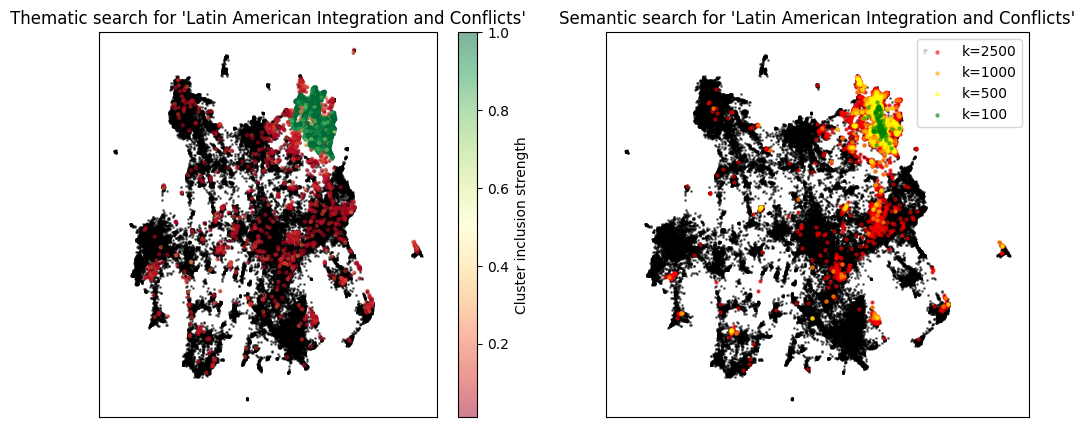
For a bit of visualization, we can colour a scatter plot of the samples by their inclusion strength in a topic of choice. We can also compare the topology of thematic and semantic search:
[28]:
import matplotlib.pyplot as plt

topic = (3,3)

topic_info = topicdb.q.topic(*topic).info()

interior_index = topicdb.q.topic(*topic).samples(0.95).indices
bdry_index = topicdb.q.topic(*topic).samples(0.01).indices
strengths = topicdb.soft_cluster_tree.strengths(topic_info.index[0], bdry_index)

fig,(ax1,ax2)=plt.subplots(1,2, figsize=(12,5))
ax1.set_title(f"Thematic search for '{topic_info.name.values[0]}'")
ax1.scatter(
    topicdb.reduced_vectors[:,0], topicdb.reduced_vectors[:,1],
    s=1, c='k', alpha=0.5
)
sc=ax1.scatter(
    *topicdb.reduced_vectors[bdry_index].T,
    s=5, c=strengths, cmap='RdYlGn',
    alpha=0.5
)

plt.colorbar(sc, label="Cluster inclusion strength")
ax1.set_xticks([])
ax1.set_yticks([])
ax2.scatter(
    *topicdb.reduced_vectors.T, s=1, c='k', alpha=0.5
)

colours = [
    'red','orange','yellow','green'
]
ax2.set_title(f"Semantic search for '{topic_info.name.values[0]}'")
for i, k in enumerate([2500,1000,500,100]):
    nn_idx = topicdb.q.neighbours(topic_info.name.values[0], k=k).indices
    vectors = topicdb.reduced_vectors
    ax2.scatter(
        vectors[nn_idx, 0],
        vectors[nn_idx, 1],
        s=5,
        c=colours[i],
        alpha=0.5,
        label=f"k={k}"
    )
ax2.legend()
ax2.set_xticks([])
ax2.set_yticks([])
plt.show()